Hope is not a strategy


Hope is not a strategy—or so I’ve been told more than once.
I tend to lean on hope as a strategy when I don’t want to face what’s in front of me. If I trip on the sidewalk outside the courthouse, I hope no one saw me. If I say the wrong thing in a meeting, I hope no one noticed. If I make a mistake, hurt someone’s feelings, or put my foot in my mouth, I hope it quietly disappears from everyone’s memory.
But in those moments, “hope” is really avoidance dressed up as wishful thinking—the desire to bypass the embarrassment, the accountability, the apology. And that kind of hope, as comforting as it feels, isn’t a strategy at all.
Because hope matters deeply to me, I pay attention to how others talk about it. I recently found a quote that resonated—not only for those small moments I’d prefer to forget, but also for CASA of Kent County’s work in the child welfare system.
Anticipatory hope suggests that
someday, somehow, things will get better.
But it’s fragile as an eggshell.
Participatory hope is rooted in the present.
It sees the broken things and says,
“Here is where we begin.”
—Jonathan Merritt
If I am going to live into participatory hope, I have to accept the helping hand when I trip, try again when I miss the mark, and do the hard work of owning my words and making things right.
The same kind of participatory hope is necessary for anyone invested in CASA’s mission.
We can’t just “hope” child abuse will go away.
We can’t just “hope” trauma stays hidden or fades with time.
We can’t just “hope” children forget what they’ve endured.
And we can’t just “hope” they return home or find another safe, loving, permanent family.
Participatory hope asks us to stay present, see what’s broken, and begin. So, what does that look like?
Seeing clearly that our child welfare system is overburdened and under-resourced.
Acknowledging that parents don’t set out to harm their children.
Recognizing how inequitable systems push families to the brink.
Remembering that foster care itself creates additional trauma.
Knowing that children in care often feel alone, powerless, and unsure of what comes next.
Participatory hope means stepping toward the work rather than standing on the sidelines.
For some, that means walking alongside a child in foster care as a CASA volunteer—a steady, trusted adult who listens, advocates, and helps a child feel seen.
For others, it means fueling this work financially so that more children can have a CASA by their side.
And for many, it means using your voice: sharing CASA’s mission, inviting others to volunteer, or helping your community understand why this work matters. Sharing the mission is its own form of participatory hope.
Because real hope asks something of us.
It asks us to begin where things are broken, take the next right step, and believe that our collective action can change a child’s life.
This is participatory hope at CASA of Kent County.
And we need more of it.
We need more of you.
Your generous support makes our work possible. Make a gift of hope today by visiting this link.
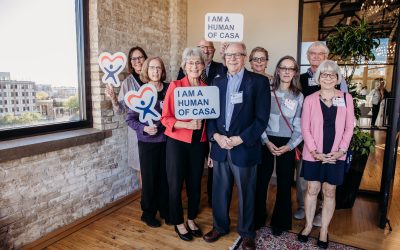
For Heart of CASA, the annual fundraising dinner and award ceremony, the CASA team decided to take the opportunity of having the CASA community gathered to feature some of the Humans of CASA – in person. Thus, this year’s theme was born: Meet the humans. Feel the heart.

A month or so ago, I was reminded in the sweetest way of how lasting a CASA’s impact can be. While I was meeting with a prospective board member at a local coffee shop, a woman approached me and said, “We’ve never met, but my son, Peter, remembers you. He had a CASA — Miss Cindy.”

AS 2025 DRAWS TO A CLOSE, we reflect on a remarkable year of connection, advocacy, and community.
Being an informed community member will better equip you to advocate for vulnerable children in our community. Subscribe to our email list to stay up to date on CASA of Kent County news, stories, events, and more. We promise not to overwhelm you with too many emails!
"*" indicates required fields